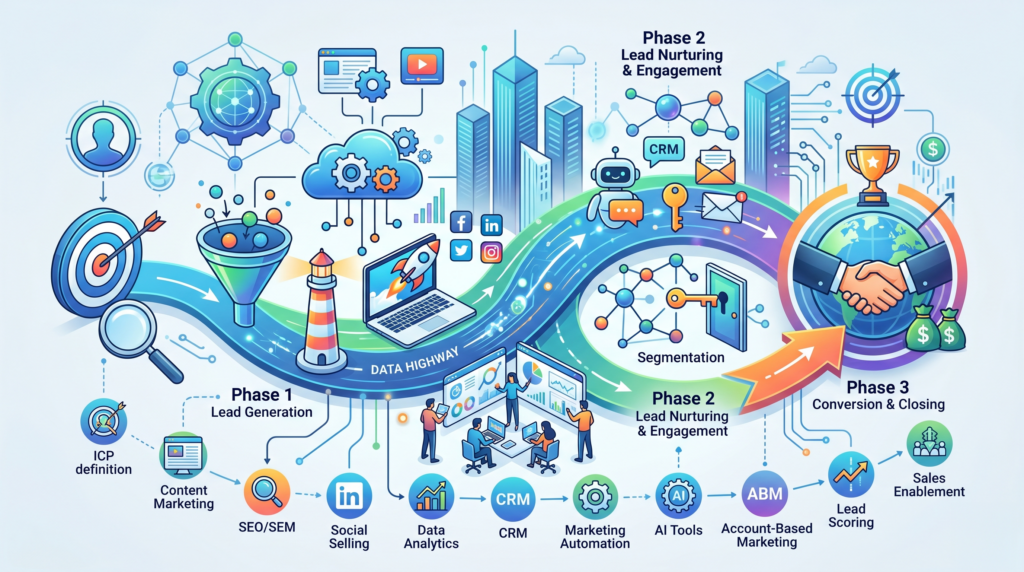
How to Build a B2B Lead Generation System in 2026
Many B2B companies still think in campaigns when what they actually need is a system. They post content, run ads, update their website from time to time, yet leads still arrive inconsistently. That is not a channel problem. It is a system problem.
In 2026, B2B marketing does not work because you are present on multiple platforms. It works because your positioning, content, funnel, conversion logic, and follow-up process are aligned. When these elements operate separately, marketing consumes time and budget without producing predictable business results.
B2B lead generation is not a campaign. It is infrastructure.
For most companies, the core issue is not a lack of activity. The issue is that the path from first impression to inquiry is not built properly. There is a website, some social media activity, maybe occasional advertising, but no clear answer to who the company wants to reach, what problem it solves, what offer it presents, and how that journey is structured.
A well-functioning B2B lead generation system does not rely on improvisation. It knows who it wants to attract. It knows how to translate a business problem into a relevant market message. And it knows how to guide prospects from awareness to trust and from trust to action.
1. Without positioning, you will not get quality leads
Poor lead quality is often not caused by bad advertising. It is caused by weak messaging. If your communication is too broad, you will attract broad and low-intent interest. In B2B, that is an expensive mistake.
The goal is not to reach more people. It is to reach the right people.
Good positioning does not simply explain what you do. It defines who you help, in what business situation, and what specific problem you solve. That is especially important for companies that are strong professionally but still lack a clear strategic marketing structure.
If a B2B service company says only that it offers “complex marketing solutions,” it will not generate relevant demand. If it clearly states that it helps businesses build structured lead generation systems where expertise already exists but inbound acquisition is still inconsistent, that becomes a business-relevant message.
2. Content is not about staying visible. It is about building trust.
Content marketing usually fails when companies treat it as activity rather than as part of the sales process. In B2B, content is not there just so you have something to post. Its job is to help potential clients recognize, before they ever reach out, that you understand their problem.
That is why the blog should sit at the center of the system, while other platforms support and distribute its message. Strong B2B content does not chase vanity metrics. It reduces uncertainty, demonstrates expertise, and prepares prospects for conversion.
3. Without a funnel, attention will never become pipeline
In B2B, decisions are rarely made immediately. That means it is not enough to drive traffic to your website. The real question is what happens next.
TOFU, MOFU, and BOFU only matter if they are connected
At the top of the funnel, you build awareness and problem recognition. In the middle, you educate and qualify. At the bottom, you support decision-making. Many companies have these assets in isolation, but not as part of one coherent process.
For example, someone may read a strong expert article, but then there is no relevant offer, no downloadable resource, no audit request, and no well-structured service page waiting for them. In that case, the content worked. The system did not.
4. Conversion is not a design issue. It is business logic.
A B2B website is not effective because it looks modern. It is effective because it makes the offer easy to understand, reduces friction, and moves the visitor toward the next step.
That requires a clear value proposition, strong service pages, proof points such as case studies or references, and a CTA that is neither too aggressive nor too vague. A “Contact us” page alone is not a strategy. An audit, consultation, or short diagnostic call is.
5. Follow-up determines whether a lead becomes a client
Many B2B companies fail not because they cannot generate interest, but because they do not handle incoming leads consistently. There is no CRM logic, no prioritization, no follow-up rhythm, and no structured nurturing process.
Yet the first inquiry is not the end of the funnel. It is the beginning of the sales phase. This is where it becomes clear whether marketing has created actual pipeline or just temporary attention.
What does a B2B lead generation system need in 2026?
Not another channel. Not more random content. What it needs is a structured acquisition system where every element serves the same goal: attracting relevant prospects and moving them through a predictable process.
For most companies, the question is not whether they do marketing. The question is whether marketing is connected to growth. Without clear positioning, strategic content, a functioning funnel, conversion-focused pages, and disciplined follow-up, lead generation will remain inconsistent.
FAQ
What is the biggest mistake in B2B lead generation?
The biggest mistake is thinking in channels instead of systems. A company may have LinkedIn, ads, and a website, but still lack a structured journey from first touchpoint to qualified lead.
Is LinkedIn alone enough?
No. LinkedIn can be a strong channel, but it is not a lead generation system on its own. Without positioning, landing pages, content, and follow-up, its impact will remain limited.
How long does it take to build a working system?
It depends on the company and its starting point, but this is rarely a campaign-level task. In most cases, it requires a strategic build over several months.
Do small and mid-sized businesses need this too?
Yes. In fact, they often need it even more. When resources are limited, marketing must operate as a business system, not as scattered activity.
If your marketing is present but still not creating predictable lead flow, it is worth identifying where the system breaks down. A short audit can quickly reveal whether the bottleneck is in positioning, funnel structure, website conversion, or follow-up.